He Set Me Free Ive Been Born Again
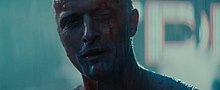
"Tears in rain" (also known as the "C-Beams Spoken language"[i]) is a 42-give-and-take monologue, consisting of the last words of grapheme Roy Batty (portrayed past Rutger Hauer) in the 1982 Ridley Scott-directed film Blade Runner. Written by David Peoples and altered by Hauer,[2] [three] [4] the monologue is frequently quoted.[five] Critic Marker Rowlands described it equally "perhaps the nearly moving death soliloquy in cinematic history",[6] and information technology is unremarkably viewed as the defining moment of Hauer'southward acting career.[seven] [viii]
Context [edit]

Hauer's chair from the picture's product
The monologue is near the conclusion of Blade Runner, in which detective Rick Deckard (played past Harrison Ford) has been ordered to track down and kill Roy Derailed, a rogue artificial "replicant". In a rooftops chase in heavy rain, Deckard misses a spring and hangs by his fingers, about to fall to his death. Derailed turns back, and lectures Deckard briefly about how the tables have turned, only pulls him up to safety at the last instant. So, recognizing that his express lifespan is almost to terminate, Derailed further addresses his shocked nemesis, reflecting on his own experiences and mortality, with dramatic pauses between each statement:
I've seen things you people wouldn't believe... Attack ships on fire off the shoulder of Orion... I watched C-beams glitter in the nighttime near the Tannhäuser Gate. All those moments will be lost in time, like tears in rain... Time to die.
Script and Hauer's input [edit]
In the documentary Dangerous Days: Making Blade Runner, Hauer, director Ridley Scott, and screenwriter David Peoples ostend that Hauer significantly modified the "Tears in Rain" oral communication. In his autobiography, Hauer said he simply cutting the original scripted speech past several lines, adding only, "All those moments will exist lost in time, like tears in rain".[9] 1 earlier version in Peoples' draft screenplays was:
I've known adventures, seen places you people will never see, I've been Offworld and dorsum… frontiers! I've stood on the back deck of a blinker leap for the Plutition Camps with sweat in my optics watching stars fight on the shoulder of Orion... I've felt air current in my pilus, riding test boats off the black galaxies and seen an set on fleet burn like a match and disappear. I've seen it, felt it...![x]
And, the original script, before Hauer'southward rewrite, was:
I've seen things... seen things you lot picayune people wouldn't believe. Assail ships on burn down off the shoulder of Orion brilliant as magnesium... I rode on the back decks of a blinker and watched C-beams glitter in the dark near the Tannhäuser Gate. All those moments... they'll exist gone.[11]
Hauer described this as "opera talk" and "howdy-tech speech" with no bearing on the remainder of the film, then he "put a knife in it" the night before filming, without Scott'south knowledge.[12] Afterward filming the scene with Hauer's version, crew-members applauded, with some even in tears.[vii] In an interview with Dan Jolin, Hauer said that these final lines showed that Batty wanted to "make his marker on existence ... the replicant in the final scene, by dying, shows Deckard what a real man is made of".[13]
Critical reception and analysis [edit]
Sidney Perkowitz, writing in Hollywood Science, praised the oral communication: "If there's a corking speech in science fiction cinema, it's Batty's concluding words." He says that it "underlines the replicant's humanlike characteristics mixed with its artificial capabilities".[14] Jason Belong, writing in Future Imperfect: Philip Chiliad. Dick at the Movies, praised the delivery of the speech: "Hauer'southward deft performance is heartbreaking in its gentle evocation of the memories, experiences, and passions that have driven Batty's short life".[15]
The Guardian writer Michael Newton noted that "in one of the motion picture's well-nigh brilliant sequences, Roy and Deckard pursue each other through a murky apartment, playing a vicious child'due south game of hide and seek. As they do and then, the similarities between them abound stronger – both are hunter and hunted, both are in pain, both struggle with a hurt, claw-like hand. If the film suggests a connection here that Deckard himself might withal at this indicate deny, at the very end doubtfulness falls away. Roy's life closes with an act of pity, i that raises him morally over the commercial institutions that would impale him. If Deckard cannot see himself in the other, Roy tin. The white dove that implausibly flies upwards from Roy at the moment of his death possibly stretches belief with its symbolism; just for me at least the movie has earned that moment, suggesting that in the replicant, as in the replicated technology of film itself, at that place remains a place for something human."[16]
Afterwards Hauer'southward death in July 2019, Leah Schade of the Lexington Theological Seminary wrote in Patheos of Derailed as a Christ effigy. She comments on seeing Batty, with a blast through the palm of his hand, addressing Deckard, who is hanging from one of the beams:
Then, equally Deckard dangles from the steel beam of a rooftop after missing his bound across the chasm, Roy appears holding a white dove. He jumps across to Deckard with ease and watches his hunter struggle to hold on. 'Quite an experience to alive in fear, isn't it? That'south what it is to be a slave.' Then, only as Deckard's hand slips, Roy reaches out and grabs him – with his boom-pierced manus. He lifts up Deckard and swings him onto the roof in a final act of mercy for the man who had killed his friends and intended to impale him. In that moment, Roy becomes a Christ-similar figure, his manus reminiscent of Jesus'south ain manus nailed to the cross. The crucifixion was a saving deed. And Roy's stunning final human activity – saving Deckard when he did not at all deserve saving – is a powerful scene of grace.[17]
Tannhäuser Gate [edit]
The place named "Tannhäuser Gate" (too written "Tannhauser Gate" and "Tanhauser Gate") is not explained in the film. It perchance derives from Richard Wagner'due south operatic accommodation of the legend of the medieval German knight and poet Tannhäuser.[18] The term has since been reused in other scientific discipline fiction sub-genres.[19]
Joanne Taylor, in an commodity discussing pic noir and its epistemology, remarks on the relation between Wagner's opera and Derailed's reference, and suggests that Batty aligns himself with Wagner's Tannhäuser, a character who has fallen from grace with men and with God. Both man and God, equally she claims, are characters whose fate is beyond their ain control.[18]
Noteworthy references [edit]
The speech appears equally the last rail on the movie's soundtrack album.[20]
Its influence can be noted in references and tributes, including:
When David Bowie'southward half-brother Terry Burns died by suicide in 1985, the note fastened to the roses that Bowie (a fan of Blade Runner)[21] sent to his funeral read "You've seen more things than we can imagine, simply all these moments will be lost, like tears washed away by the rain. God bless yous. —David."[22] [23]
The 1998 film Soldier, which was written by Blade Runner co-writer David Peoples and is considered by Peoples to exist set in the same universe equally Blade Runner, features a subtle reference to the scene when Kurt Russell'south character is revealed to have fought at the Battle of Tannhauser's Gate.[24]
In Tony Scott's 2005 film Domino, Keira Knightley'due south character has a tattoo on the back of her neck that reads, "Tears in the Rain". This was an homage to his brother Ridley Scott, who directed Blade Runner.[25]
Rutger Hauer titled his 2007 autobiography All Those Moments: Stories of Heroes, Villains, Replicants, and Blade Runners.[26] His family quoted the final two sentences of the monologue in his obituary notice.[27]
In the first flavor of Netflix'southward live activeness remake of Cowboy Bebop, during the eighth episode, Sad Clown A-Get-Go, Pierrot Le Fou paraphrases the "Tears in the Rain" monologue.[28] Afterwards, Jet Black asks Fasten Spiegel if he served at the shoulder of Orion or the Tannhäuser Gate.[29]
References [edit]
- ^ Bract Runner: The Final Cut (Commentary Runway). Ridley Scott. Warner Bros. 2007 [1982].
{{cite AV media notes}}: CS1 maint: others in cite AV media (notes) (link) - ^ Huw Fullerton (2017), Interview with Rutger Hauer, archived from the original on July 20, 2018, retrieved July twenty, 2018
- ^ Ridley Scott; Paul Sammon (2005), Ridley Scott: interviews, University Press of Mississippi, p. 103
- ^ Jim Krause (2006), Type Thought Index, p. 204, ISBN978-ane-58180-806-three
- ^ Marker Brake; Neil Hook (2008), "Dissimilar engines", Scientific American, Palgrave Macmillan, 259 (6): 163, Bibcode:1988SciAm.259f.111E, doi:ten.1038/scientificamerican1288-111, ISBN978-0-230-55397-2
- ^ Marking Rowlands (2003), The Philosopher at the Terminate of the Universe, pp. 234–235,
Roy and then dies, and in perhaps the nearly moving death soliloquy in cinematic history...
- ^ a b Fullerton, Huw (July 25, 2019). "Rutger Hauer dissects his iconic "tears in pelting" Blade Runner monologue". Radio Times. Archived from the original on July 20, 2018. Retrieved July 30, 2020.
- ^ Miller, Matt (July 24, 2019). "Rutger Hauer's 'Tears in the Rain' Voice communication From Bract Runner Is an Iconic, Improvised Moment in Film History". Esquire. Archived from the original on July xviii, 2020. Retrieved July 30, 2020.
- ^ Rutger Hauer & Patrick Quinlan (2007), All Those Moments: Stories of Heroes, Villains, Replicants and Blade Runners, HarperEntertainment, ISBN978-0-06-113389-3
- ^ Scott Myers (December 3, 2009). ""Blade Runner" dialogue analysis". Archived from the original on July 22, 2020. Retrieved December 6, 2018.
- ^ Hampton Fancher & David Peoples (Feb 23, 1981). "Blade Runner Screenplay". Archived from the original on June 10, 2007. Retrieved March xi, 2010.
- ^ 105 minutes into the Channel 4 documentary On the Border of Blade Runner.
- ^ Laurence Raw (2009), The Ridley Scott encyclopedia, p. 159, ISBN978-0-8108-6952-3, archived from the original on December ix, 2020, retrieved September 26, 2020
- ^ S. Perkowitz (2007), Hollywood science, Columbia University Press, p. 203, ISBN978-0-231-14280-nine, archived from the original on January twenty, 2021, retrieved September 26, 2020
- ^ Jason P. Belong (2009), Future Imperfect, Academy of Nebraska Printing, p. 24, ISBN978-0-8032-1860-4, archived from the original on January xx, 2021, retrieved September 26, 2020
- ^ Newton, Michael (March 14, 2015). "Tears in rain? Why Blade Runner is timeless". The Guardian. London. Archived from the original on June 17, 2017. Retrieved July 26, 2017.
- ^ Schade, Leah D. (July 25, 2019). "Similar Tears in Pelting: Rutger Hauer, Bract Runner, and Existence Fully Human". Patheos. Archived from the original on August 9, 2019. Retrieved November 24, 2019.
- ^ a b Taylor, Joanne (2006), "'Hither'southward to Plain Speaking': The Condition(s) of Knowing and Speaking in Film Noir", Florida Atlantic Comparative Studies, 48: 29–54, ISBN978-1-58112-961-8, archived from the original on June 28, 2014, retrieved Oct 26, 2016
- ^ Hicham Lasri, Static, ISBN 978-9954-1-0261-9, pp. 255
- ^ Johnson, Zac (2011). "Blade Runner – Vangelis". AllMusic. Archived from the original on February 28, 2021. Retrieved August 21, 2020.
- ^ Rogers, Jude (January 21, 2016). "The terminal mysteries of David Bowie's Blackstar – Elvis, Crowley and 'the villa of Ormen'". The Guardian. Archived from the original on February 14, 2016. Retrieved February 24, 2019.
- ^ Gilmore, Mikal (February 2, 2012). "David Bowie: How Ziggy Stardust Fell to Globe". Rolling Rock. Archived from the original on February 25, 2019. Retrieved February 24, 2019.
- ^ Trynka, Paul (2011). David Bowie: Starman. Trivial, Brownish and Visitor. p. 397. ISBN978-0-316-03225-4. Archived from the original on February 28, 2021. Retrieved February 24, 2019.
- ^ "The Weird Earth of Blade Runner Spinoffs". October 2, 2017.
- ^ "Listen to Keira Knightley & Director Tony Scott Talk 'Domino'". Movieweb. Oct thirteen, 2005. Archived from the original on August xv, 2019. Retrieved August fifteen, 2019.
- ^ Gilbey, Ryan (July 25, 2019). "Rutger Hauer obituary". The Guardian . Retrieved Nov 24, 2019.
- ^ "Rutger Hauer obituary discover". Retrieved Apr 8, 2021.
- ^ "Cowboy Bebop: Every anime Easter egg in Season 1". Polygon. November 19, 2021. Retrieved November 23, 2021.
- ^ "Cowboy Bebop Recap: The Tears of a Clown". New York Magazine Vulture. November 21, 2021. Retrieved November 21, 2021.
Source: https://en.wikipedia.org/wiki/Tears_in_rain_monologue

Mag-post ng isang Komento for "He Set Me Free Ive Been Born Again"